Effective currency risk management requires more than knowing your current exposure, hedge ratio or where exchange rates are trading.
Most companies can answer questions about their current position:
- What is our current FX exposure?
- What is our hedge ratio?
- Where is the exchange rate trading?
Yet many struggle to answer a much more important question:
Where is our business expected to finish if today’s exchange rates remain unchanged?
Most companies do not know.
Market Visibility Is Not Decision Visibility
Knowing the market is not the same as knowing what the market means for your business.
An exchange rate does not tell you whether profitability is still on track.
The daily exchange rates published by the Bank of Canada provide a useful market reference. But on their own, they cannot explain the expected impact on a company’s profitability.
An exposure report does not tell you whether your financial objectives are still achievable.
A hedge ratio does not tell you whether your remaining FX risk tolerance is sufficient.
These indicators describe the company’s position and the current market environment. But taken separately, they do not explain the expected impact on future profitability.
This is the difference between market visibility and Decision visibility.
Market visibility tells you what is happening.
Decision visibility tells you what it means for the business.
What Decision Visibility Should Tell Finance
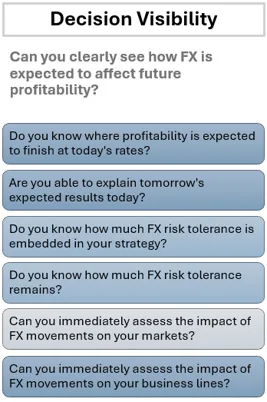
Decision visibility connects exchange rates to the company’s own financial context. It should allow finance teams to answer questions such as:
- Where is profitability expected to finish at today’s exchange rates?
- Can tomorrow’s expected results already be explained today?
- How much FX risk tolerance has already been consumed?
- How much flexibility remains?
- Which markets or business lines are becoming more vulnerable?
- Are current hedges still aligned with the company’s objectives and risk tolerance?
Without these answers, decisions do not stop[1] . They simply become harder to justify.
Not because finance lacks data, but because the available information does not yet explain the business impact.
Finance Does Not Need More Data. It Needs Connected Data.
Most finance teams already have the necessary information:
- budgets;
- FX exposures;
- existing hedges;
- business units;
- markets;
- profitability targets;
- risk tolerance.
The challenge is not collecting more data. The challenge is connecting it.
Identifying exposure and measuring its financial impact are the first steps in a structured approach to FX risk management. This information must then be linked to the company’s objectives and risk tolerance to guide decisions over time.
A budget establishes the company’s financial objectives. FX exposures identify which revenues, costs or commitments could be affected by exchange rates. Existing hedges show how much protection is already in place. Risk tolerance defines how much deviation the company is prepared to accept.
Individually, each element provides useful information.
Connected, they provide the financial context required to determine whether action is justified.
From FX Reporting to Forward-Looking Decision-Making
Once these elements are connected, something changes.
Finance no longer reports only what happened. It begins to explain where the business is heading under today’s conditions.
Management can see whether expected profitability remains aligned with the budget, how much risk tolerance has been consumed and how much flexibility remains before action becomes necessary.
The objective is not simply to hedge more or react more quickly to market movements.
It is to understand when changing market conditions create a meaningful business impact—and when that impact justifies action [2].
Only then can management confidently ask the next question: What should we do?
How many of these questions can your finance team answer today?