

When to Hedge FX Risk: Seeing the Risk Doesn’t Tell You What to Do
In the previous article, we explained why decision visibility matters [1].
Knowing where your company’s profitability is expected to land at today’s exchange rates changes the nature of the conversation. But it still does not tell you when to hedge FX risk.
The next question remains: What should we do?
Understanding FX Exposure Is Not Enough
This is where many finance teams struggle.
They understand their exposures. They can see the expected impact on profitability.
Identifying how FX risk affects business operations is also one of the foundations of a more effective FX hedging strategy.
Yet the decision itself often remains subjective.
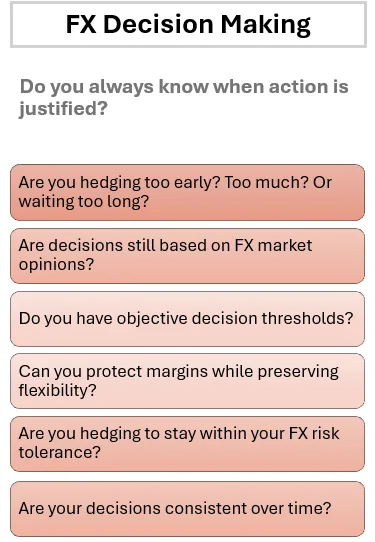
Should we hedge now?
Should we wait? Increase hedge coverage? Reduce it?
Do nothing?
Understanding the risk helps explain the situation. It does not determine when action becomes justified.
Market Opinions Do Not Tell You When to Act
Too often, hedging decisions are influenced by market opinions rather than business objectives.
Teams debate whether the dollar will rise or fall. Banks communicate their market views. Analysts publish forecasts. Everyone has an opinion.
But those opinions rarely answer the most important question:
Has the company reached a point where action is truly justified?
This question changes the nature of the conversation.
Instead of asking:
“Where do we think the market is going?”
Finance can begin asking:
“What does today’s market mean for our business?”
The distinction is subtle but important.
The first question focuses on predicting markets. The second focuses on managing business performance.
Decision Markers for Determining When to Hedge FX Risk
This is where objective decision markers become valuable.
Rather than making isolated hedging decisions, companies can establish predefined thresholds based on their own financial situation.
For example:
- projected profitability;
- remaining FX risk tolerance;
- expected margin deterioration;
- hedge coverage already in place.
As long as these markers remain within acceptable limits, there may be no reason to act.
When they move beyond those limits, the company’s financial situation—not the market—signals that action has become justified [2].
Thresholds That Strengthen Judgment
Establishing thresholds does not replace judgment. It strengthens it.
Management still decides. The bank still advises. But everyone now works from the same company-specific financial context.
The objective is not to hedge earlier. Nor is it to hedge more.
The objective is to act when the company’s situation justifies it while preserving as much flexibility as possible.
Keeping the FX Hedging Strategy Aligned Over Time
This naturally leads to another question. Once the decision has been made…
How do we ensure the strategy remains aligned as business conditions continue to evolve?
That is the subject of the next article: One Good Decision Isn’t Enough. Decision Alignment Is What Creates Value.
How many of these questions can your finance team answer today?
[1] Before You Can Make Better FX Decisions, You First Need Better Visibility
[2] One Good Decision Isn’t Enough. Decision Alignment Is What Creates Value.